
Tuesday, April 22, 2025
A Planetary Nebula Purgathofer-Weinberger 1 (PuWe1) is the Last Photo for Now
I spent total 36 hours of collecting 20 min. exposures for this cosmic smoke ring with narrowband filters, H-alpha, S-II and O-III. PuWe1 locates in constellation lynx at distance of about 1300 light years.
This is my last new photo for the imaging season 2024-25, we ran out of the astronomical darkens at May 7. Deep sky imaging is possible again after the first week of September. up here 65N.
PuWe1
Click for a large image, 2000 x 2000 pixels

A mapped color image from a light emitted by an ionized elements, sulfur=red, hydrogen=green and oxygen=blue. Original resolution 6500 x 6500 pixels
A Closeup
Click for a large image, 1600 x 1600 pixels

Image in visual colors
Click for a large image, 2000 x 2000 pixels

The emission from H-alpha and S-II are seen as red, blueish tones are from an emission of ionized oxygen, O-III. This combination is very close to a visual colors of the nebula.
A size comparison between M27 and PuWe1
Click for a large image, 2000 x 2300 pixels

Note, a size of the Full Moon is marked as a white circle as a scale.
The apparent size of the Full Moon in the sky is 30 arc minutes (0,5 degrees)
Technical details
Processing workflow
Image acquisition, MaximDL v6.5
Stacked and calibrated in CCDStack2.
Deconvolution with a CCDStack2 Positive Constraint, 27 iterations, added at 50% weight
Color combine in PS
Levels and curves in PS
Imaging optics,
Celestron EDGE 14" with 0.7 Focal reducer
Mount,
MesuMount Mark II
Cameras,
Imaging camera Apogee Alta U9000M and Apogee seven slot filter wheel
Guider camera, Lodestar x 2 and SXV-AO Active Optics @ 5hz
filters,
Astrodon 5nm H-alpha, 3nm S-II and 3nm O-III
Total exposure time 36h
H-alpha, 72 x 1200 s, binned 1x1 = 24 h
O-III, 6x 1200 s, binned 2x2 = 6h
O-III, 6x 1200 s, binned 2x2 = 6h
S-II, 6 x 1200 s. binned 2x2 = 6h


Saturday, April 19, 2025
Soul Nebula, a Two Frame Panorama
I published yesterday a detail picture of the Soul nebula, IC 1848. Earlier this year I shot another long focal length photo of the IC 1848, those two photos are overlapping so I was able to make a two frame mosaic out of them, total exposure time 30h
Soul Nebula, a Two Frame Panoramic Mosaic Image
Click for a large image, 2800 x 1700 pixels
Click for a large image, 2800 x 1700 pixels
 A mapped color image from a light emitted by an ionized elements, sulfur=red, hydrogen=green and oxygen=blue. Original resolution 8500 x 5000 pixels
The Soul Nebula, a Wider Filed Shot
Click for a large image, 3000 x 1700 pixels

Technical details
Processing workflow
Image acquisition, MaximDL v6.5
Stacked and calibrated in CCDStack2.
Deconvolution with a CCDStack2 Positive Constraint, 27 iterations, added at 50% weight
Color combine in PS
Levels and curves in PS
Imaging optics,
Celestron EDGE 14" with 0.7 Focal reducer
Mount,
MesuMount Mark II
Cameras,
Imaging camera Apogee Alta U9000M and Apogee seven slot filter wheel
Guider camera, Lodestar x 2 and SXV-AO Active Optics @ 5hz
filters,
Astrodon 5nm H-alpha, 3nm S-II and 3nm O-III
Total exposure time 30h
H-alpha, 75 x 1200 s, binned 1x1 = 25 h
O-III, 6x 1200 s, binned 2x2 = 5h
O-III, 6x 1200 s, binned 2x2 = 5h
S-II, 6 x 1200 s. binned 2x2 = 5h
Friday, April 18, 2025
Part of the Soul Nebula
Soul nebula, IC 1848, has been my target many times during the years. This time I have shot some details of the nebula with my current long focal length imaging system.
A Detail of Soul Nebula
Click for a large image, 2000 x 2000 pixels

A mapped color image from a light emitted by an ionized elements, sulfur=red, hydrogen=green and oxygen=blue. Original resolution 6500 x 6500 pixels
The Soul Nebula
Click for a large image, 3000 x 1700 pixels
Technical details
Processing workflow
Image acquisition, MaximDL v6.5
Stacked and calibrated in CCDStack2.
Deconvolution with a CCDStack2 Positive Constraint, 27 iterations, added at 50% weight
Color combine in PS
Levels and curves in PS
Imaging optics,
Celestron EDGE 14" with 0.7 Focal reducer
Mount,
MesuMount Mark II
Cameras,
Imaging camera Apogee Alta U9000M and Apogee seven slot filter wheel
Guider camera, Lodestar x 2 and SXV-AO Active Optics @ 5hz
filters,
Astrodon 5nm H-alpha, 3nm S-II and 3nm O-III
Total exposure time 9h
H-alpha, 51 x 1200 s, binned 1x1 = 5 h
O-III, 6x 1200 s, binned 2x2 = 2h
O-III, 6x 1200 s, binned 2x2 = 2h
S-II, 6 x 1200 s. binned 2x2 = 2h
Thursday, April 10, 2025
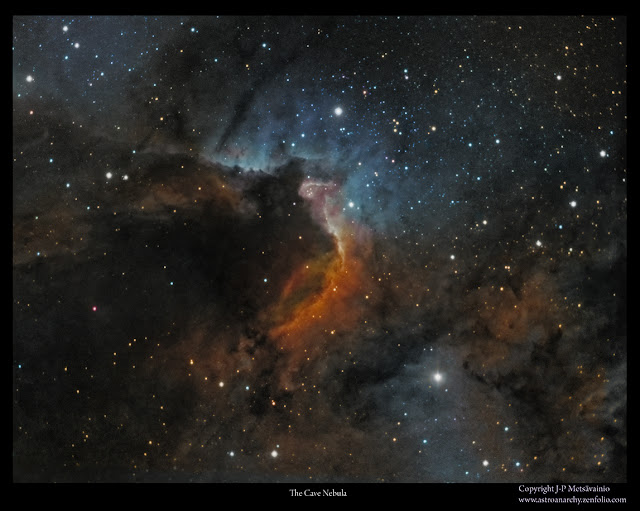
Sharpless 155, the Cave Nebula
This is one of the targets I’ve been imaging for decades using various equipment—from camera lenses (150–300mm) to large reflecting telescopes ranging from 11" to 14". (My older photos can be seen at end of this blog post)
This time, I used new imaging setup to capture a high-resolution image of Sh2-155.
The seeing conditions weren’t ideal, but I’m fairly happy with the results.
Sharpless 155 (Sh2-155), the Cave Nebula
Click for a large image, 2000 x 1900 pixels

A mapped color image from a light emitted by an ionized elements, sulfur=red, hydrogen=green and oxygen=blue. Original resolution 6500 x 5500 pixels
Sharpless 155 in Visual Palette
Click for a large image, 2000 x 1900 pixels

Visual color version of Sh2-155 glows mostly in red from a light emitted by an ionized elements,
sulfur=red, hydrogen=red and oxygen=blue, this combination is very close to a natural color palette.
sulfur=red, hydrogen=red and oxygen=blue, this combination is very close to a natural color palette.
Info
Sh2-155—also known as Caldwell 9, Sharpless 155, S155, or LBN 529—is a diffuse nebula located in the constellation Cepheus. It lies within a larger nebula complex that includes emission, reflection, and dark nebulosity. It’s widely known as the Cave Nebula. (Note: The reflection component is not visible in my narrowband image.)
The nebula is approximately 2,400 light-years away. This photo covers an area of about 0.7 × 0.7 degrees of the sky—for reference, the full Moon has a diameter of 0.5 degrees, or 30 arcminutes.
Technical details
Processing workflow
Image acquisition, MaximDL v6.5
Stacked and calibrated in CCDStack2.
Deconvolution with a CCDStack2 Positive Constraint, 27 iterations, added at 50% weight
Color combine in PS
Levels and curves in PS
Imaging optics,
Celestron EDGE 14" with 0.7 Focal reducer
Mount,
MesuMount Mark II
Cameras,
Imaging camera Apogee Alta U9000M and Apogee seven slot filter wheel
Guider camera, Lodestar x 2 and SXV-AO Active Optics @ 5hz
filters,
Astrodon 5nm H-alpha, 3nm S-II and 3nm O-III
Total exposure time 21h
H-alpha, 51 x 1200 s, binned 1x1 = 17 h
O-III, 6x 1200 s, binned 2x2 = 2h
O-III, 6x 1200 s, binned 2x2 = 2h
S-II, 6 x 1200 s. binned 2x2 = 2h
My older shots from the area
2008
 A photo from 2008, https://astroanarchy.blogspot.com/2008/10/sh2-155-cave-nebula.html
2008
2011

2012

Subscribe to:
Posts (Atom)


